

Protocol — reference
High Yield v1.4
Current stage: Flowering
Reference
- Temperature24–26 °C
- Relative humidity55–65%
- VPD0.9–1.2 kPa
- CO₂800–1,000 ppm
- PPFD600–900 µmol/m²/s
Deep Garden for breeders
Turn your knowledge into structured protocols and, over time, build evidence about how your cultivars behave across different environments.
A bridge between genetics and operations
Deep Garden connects genetics, agronomic protocols, and cultivation data in one infrastructure. Knowledge no longer stays only in tech sheets — it follows the cultivar through its operation.
Genetics
What is being grown.
Protocol
How that genetics should be grown.
Cycle
How the program is applied in this grow.
Environment
What is happening in real time.
Cognition
Where reference and reality meet.
AKB — Agronomic Knowledge Base
Create specific programs for each cultivar and production objective. Structure stages, environmental parameters, nutrition, irrigation, and management into versioned recipes that can evolve over time.
Versioned recipes
Update knowledge without losing history or traceability.
Different objectives
Create specific strategies for yield, efficiency, quality, or research.
Bound to genetics
Associate each protocol directly with the matching cultivar.
Documented origin
Record authorship, sources, references, and evidence.
Cultivar
Strawberry Eclipse
Example · Horizon Genetics
Strawberry · Hybrid
Typical cycle
70–85 days
Environment
Indoor · Greenhouse
Density
8–12 pl/m²
AKB confidence
High
Interactive illustrative UI based on the platform AKB and editors.
From protocol to operation
Protocols can be applied to cultivation cycles and used by Deep Garden infrastructure as a reference to configure routines, guide compatible automation, and track the expected conditions for each stage.
Growers should not only know what to do. Deep Garden helps them see whether the grow is following the program.
Protocol
Cultivar, stage, targets, and recipe version
Cycle
Operational program for this grow
Environment + equipment
Sensors, Growbot, Aerocloner, and available infrastructure
Operation
Monitoring, routines, and supported automation
Cognition
Compare, surface deviations, and guide
Protocol — reference
High Yield v1.4
Current stage: Flowering
Reference
Observed environment
Recent telemetry
Observed
Cognition
Outside the reference range
Copilot
Relative humidity is below the protocol range defined for this stage.
Illustrative example. Numeric recommendations come from AKB targets — they do not invent setpoints. Alerts and automation depend on environment capabilities.
Monitor
Track environmental conditions against the program.
Detect
Identify when the grow drifts from the agronomic reference.
Alert
Signal conditions that need grower attention.
Guide
Provide context based on the protocol and current stage.
The same agronomic knowledge system can support different stages and Deep Garden infrastructure — from propagation to production — adapting the program to the stage, available equipment, and automation capabilities of each environment. Propagation and production programs remain distinct when the model requires it.
Propagation
Versioned programs for Aerocloner and cloning phases.
Production
Cultivation protocols applied to the cycle and its stages.
Environment
Growbot and sensors to monitor and run compatible routines.
Cognition
Comparison between agronomic reference and observed conditions.
Structured protocols, monitoring, and Cognition help growers stay closer to the recommended conditions for each genetic and stage — narrowing the gap between recommendation and execution.
From knowledge to cultivation. From cultivation back to knowledge.
From field to knowledge
Environmental data, operational conditions, observations, and results help explain how a genetics behaves across different contexts. When a learning is validated, it can support a new version of the protocol.
01
Grows
Real experiences
02
Data
Environment + operations
03
Analysis
Patterns and hypotheses
04
Validation
Technical review
05
New version
Updated knowledge
From knowledge to cultivation. From cultivation back to knowledge.
Protocol → real cultivation → telemetry + observations → analysis → validation → new version. Telemetry does not change protocols automatically.
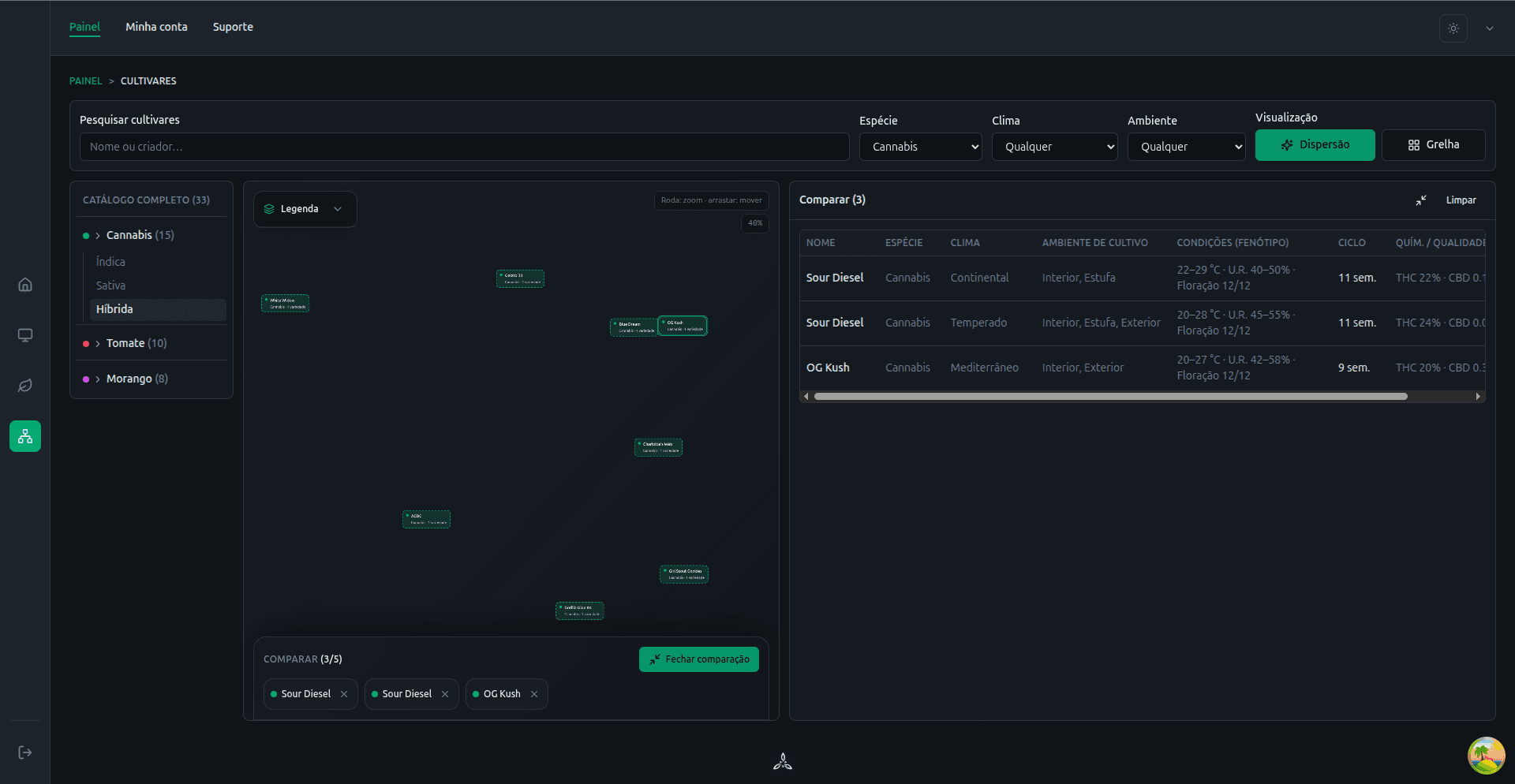
Cultivar Knowledge Network
Catalog, genealogy, protocols, evidence, observed grows, and technical discussions gathered in one structure.
From genetic identity to agronomic knowledge — in one structure.
The cultivar map and catalog already exist on the platform. Evidence, aggregated cultivation data, and discussions advance with the Founding Breeders program.
Knowledge with provenance
In Deep Garden, knowledge is not just a number in a table. Recommendations can carry authorship, version, source, and evidence level — making it possible to distinguish breeder guidance, scientific literature, agronomic observations, and real cultivation data.
Breeder
ReferenceOfficial recommendation
Guidance attributed to the genetics organization
Science
ReferenceLiterature and research
Citations and references linkable to the protocol
Field
ObservedObserved grows
Data and reports from real cycles
AKB
ReferenceKnowledge resolved for context
Parameters applicable to the stage and protocol in use
Observed values inform review — they do not automatically become recommendations.
For teams developing genetics
Document protocols by cultivar, stage, and objective with versioning, authorship, and references.
Bring that knowledge to whoever grows your genetics — protocols can follow cycles and serve as an operational reference.
Monitoring and Cognition compare environment and reference to surface deviations and guide decisions.
See how genetics behave across environments and use evidence to support new hypotheses and versions.
Onboarding
01
Grow guides, tech sheets, PDFs, spreadsheets, and internal recommendations.
02
We organize cultivars, stages, objectives, protocols, and references.
03
Your technical team validates the knowledge before publication.
04
Genetics join the catalog and can receive official protocols.
FAQ
AKB is Deep Garden’s agronomic reference layer: versioned programs and protocols by cultivar, stage, and objective, with authorship and traceability.
Yes. Protocols can be applied to growing cycles and used as an operational reference by Deep Garden infrastructure — for routines, monitoring, and automation compatible with available equipment.
Cognition compares observed conditions with the protocol and current-stage reference, surfacing deviations and providing context to guide decisions — without inventing numeric setpoints outside the AKB.
It is early onboarding for breeders, seed companies, and breeding programs that want to structure genetics, protocols, and evidence on the Deep Garden platform.
Founding Breeders program
We are inviting breeders, seed companies, and breeding programs to structure the first integrations between genetics, agronomic protocols, and real cultivation data in Deep Garden.
As a Founding Breeder, you receive: